Every horse owner should know the more subtle signs of colic because, contrary to what many people imagine, the early signs of colic are often not dramatic at all. The picture many owners immediately associate with colic is a horse rolling, pawing repeatedly, sweating heavily, kicking or biting at the belly or showing obvious distress. That certainly happens, but very often the earliest stage looks quite different.
In many cases, the first signs are mild enough to be easily overlooked or even explained away as ordinary behaviour.
Recognising these early signs matters because colic is always a medical emergency. The earlier a colicking horse receives proper veterinary treatment, the greater the chances of a positive outcome1. Even cases that initially appear mild can deteriorate significantly and quite rapidly if treatment is delayed. That is why recognising subtle behavioural changes that may indicate the beginning of colic is such an important skill for any horse owner to develop.
What colic actually means in horses
Before looking at these signs in detail, it is worth briefly clarifying what the term colic actually means, because this often causes confusion. Colic is not a disease in itself. It is a clinical syndrome that indicates abdominal pain.
Although colic is most commonly associated with the digestive system, it is important to remember that not every case of colic is caused by a problem within the digestive tract. Most cases do originate there, but because colic simply means abdominal pain, similar signs can also be caused by problems affecting other abdominal organs. For example, a mare with ovarian pain may show behavioural signs that closely resemble digestive colic.
This is important because the behavioural signs of colic often reflect neither the cause nor the severity of the underlying problem.
Why early signs of colic can be easily missed
The difficulty is that many early signs of abdominal discomfort are behaviours that horses also display under completely normal circumstances. A horse may paw. A horse may yawn. A horse may lie down. A horse may swish its tail or show flehmen.
None of these behaviours automatically means that something is wrong.
What matters is understanding when a behaviour fits the situation and is therefore normal, and when it no longer does and should raise concern. That is why recognising early colic is less about memorising a list of signs and more about learning how to interpret behaviour correctly.
What subtle signs can appear early in colic?
Among the more subtle behavioural signs of abdominal pain that may appear in the early stages of colic are:
- Flehmen response
- Repetitive yawning
- Reduced appetite or slower eating
- Short periods of social withdrawal
- Repeated lying down or frequent changes of position
- Pawing
- Tail swishing
- High tail carriage
- Standing stretched out
- Mild restlessness
- Looking at the flank intermittently
What these signs look like and when they are completely normal
Flehmen response
The flehmen response is the characteristic behaviour in which the horse curls the upper lip, exposes the front teeth, stretches the neck slightly, and usually holds the head still for a few seconds while appearing to inhale. This movement helps direct certain odours towards a specialised sensory structure called the Vomeronasal organ, located at the base of the nasal cavity, where chemical signals can be analysed more precisely than through ordinary smell alone.
It is a normal behaviour seen in horses of all ages and in both sexes, although it is more frequently displayed by stallions and young colts. Horses most commonly show flehmen when exposed to urine, reproductive odours, unfamiliar smells, or other scents that appear particularly relevant to them.
Repetitive yawning
Yawning consists of a slow, wide opening of the mouth, usually accompanied by extension of the neck and brief closure of the eyes. It is a normal behaviour that can be seen during quiet periods, after resting, or after stretching movements.
Yawning is also commonly observed after brief periods of stress or heightened alertness, when the horse shifts from a state of sympathetic activation — the physiological state associated with increased vigilance and readiness to react — back towards a more relaxed parasympathetic state. For this reason, horses often yawn after a stressful or tension-inducing event, once the stimulus has passed and the body begins to return to a calmer physiological state.
Slower eating or reduced appetite
A horse may still approach feed and begin eating, but chew more slowly than usual, interrupt feeding repeatedly, leave part of the ration unfinished, or lose interest after only a few mouthfuls. In a horse that normally eats consistently, any clear reduction in appetite should always be taken seriously, because reduced feed intake is one of the most common early signs of abdominal discomfort.
At the same time, temporary changes in eating behaviour can also occur in situations of stress or increased stimulation. A horse in a new environment, for example, may eat more slowly because attention is repeatedly drawn to unfamiliar surroundings. The horse may pause, look around, leave the feed briefly, and then return to it. Similar changes can also be seen in stallions when mares in heat are nearby, as reproductive stimulation may interfere with normal feeding behaviour.
In these situations, the change could be linked to the immediate context rather than to abdominal pain.
Social withdrawal
Horses are highly social animals, and one of the most characteristic features of normal herd behaviour is the tendency to coordinate activity. When the group grazes, most horses graze. When the group rests, most horses rest. When the herd moves, individuals usually follow that general pattern even if some variation exists. For that reason, a horse that remains apart from the group, shows less interest in joining collective activity, or appears behaviourally out of sync with the others may actually be showing discomfort.
At the same time, brief moments of separation are not necessarily abnormal. Individual temperament plays a role, and some horses might be naturally less socially engaged than others. A horse may also remain briefly apart simply because it has been resting and rejoins the group shortly afterwards.
What matters is whether this behaviour fits that horse’s usual pattern. In a horse that is normally well integrated in the herd, social withdrawal is often an early sign that something is not right.
Repeated lying down or frequent changes in position
Lying down is normal behaviour in horses and an essential part of proper rest. Although horses can sleep while standing, they also need periods of recumbency, particularly for deeper phases of sleep. A horse that feels safe and sufficiently relaxed in its environment will usually lie down for short periods, sometimes fully on its side. For this reason, lying down in itself should not be interpreted as abnormal.
This is particularly important in horses that have recently changed environment. A horse that has never been seen lying down in one setting may begin to do so regularly after moving to a quieter or more secure environment, simply because it now feels relaxed enough to rest more fully. That change can easily be mistaken for a problem when in reality it reflects improved comfort. Horses may also change position during rest, rise, lie down again, or stretch out fully without there being any clinical significance.
What becomes relevant is how this behaviour appears in context: how often it occurs, how long the horse remains down, whether it seems able to settle comfortably, and whether lying down is accompanied by other behavioural changes suggesting discomfort.
Pawing
Pawing consists of repeated scraping or striking movements of one forelimb against the ground. In some horses it appears as a light, intermittent scraping; in others it is more forceful and deliberate. Pawing may be seen in situations of excitement, for example when a horse anticipates feed, particularly if the horse is highly food-motivated. Stallions may also paw during moments of sexual stimulation or heightened arousal. It can also occur in situations of impatience, frustration or stress. A horse tied in place that becomes impatient, feels uncomfortable with the situation, or wants to move away may begin pawing repeatedly, sometimes combined with pulling against the rope or shifting weight.
Pawing may also have an exploratory function. Horses sometimes paw at unusual surfaces, unfamiliar objects, or changes in ground texture before stepping forward. In addition, horses may paw the ground while foraging, particularly when searching for roots or investigating material beneath the surface.
Tail swishing
Tail swishing consists of repeated lateral movements of the tail, which may range from occasional light movements to more continuous or forceful swishing. In many situations this is entirely normal. Horses commonly swish the tail in response to flies, skin irritation, or minor external stimuli.
Tail movement can also reflect emotional or physical discomfort. A horse that is irritated, tense, or experiencing mild discomfort may swish the tail more frequently even in the absence of insects. This is often seen in ridden horses, where repeated tail swishing may occur in response to discomfort, tension, pressure associated with riding, tack-related irritation, or musculoskeletal pain.
High tail carriage
High tail carriage refers to the tail being held more elevated than usual, often with visible muscular tension at the tail base. In some horses this has little significance in itself, because certain breeds naturally carry the tail higher than others as part of their normal conformation and movement.
Tail carriage also changes with emotional arousal. Horses commonly raise the tail when excited, alert, or suddenly stimulated by their surroundings. This is often particularly evident in stallions, although mares and geldings also show the same behaviour during moments of excitement or heightened activation. A horse may therefore temporarily carry the tail high during play, social interaction, sexual stimulation, or sudden environmental stimulation.
What deserves attention is a horse that moves with an elevated tail in the absence of any obvious external stimulus, especially if this represents a change from its usual behaviour.
Standing stretched out as if attempting to urinate
This is the posture in which the hindlimbs are placed slightly further back, the body appears elongated, and the horse stands as if preparing to urinate. This is entirely normal when the horse is about to urinate. What is not normal is when the horse remains in that stretched position without passing urine, or when it repeatedly alternates between a normal stance and the same stretched posture without any obvious result. This type of behaviour clearly indicates discomfort and should be taken seriously.
Mild restlessness
Mild restlessness often appears as a horse that repeatedly interrupts quiet standing: standing for a short time, taking a few steps, pausing, repositioning, looking around, and then repeating the sequence. This can also occur in normal situations of stress, unfamiliar surroundings, anticipation, or increased environmental stimulation. A horse in a new environment, for example, may remain more alert and be restless before gradually settling. Similar behaviour may also be seen while waiting for feed, anticipating turnout, or reacting to nearby activity.
Looking at the flank
Looking at the flank consists of the horse turning the head briefly towards one side of the abdomen. A single movement of this kind is not necessarily significant. Horses may look towards the flank because of a fly, a local skin irritation, or an itch. The same response may also be seen during grooming, particularly if the horse is sensitive to touch in that area. In these situations, the movement is usually brief and linked to an obvious external stimulus.
What becomes concerning is when the horse repeatedly looks towards the flank without any visible reason, particularly when the behaviour occurs again and again over a short period. Repeated flank-looking in the absence of flies, grooming, or another obvious trigger is a clear sign of discomfort.
How to judge whether a behaviour may indicate colic?
To judge whether one of these behaviours could represent early abdominal discomfort, three aspects need to be considered:
- The context in which the behaviour occurs
- Its frequency and intensity
- Whether it fits that horse’s usual behavioural pattern in that situation
These three points must always be assessed together.
1. Context
The first question is simple: does this behaviour make sense in this moment and in this situation?
If it does, the behaviour may simply reflect a normal behavioral response to what is happening around the horse.
If it does not, that is a red flag.
Let´s look at some examples:
A flehmen response immediately after investigating urine is entirely normal. The same behaviour shown repeatedly by a horse standing quietly in the stable, without any obvious olfactory stimulus, is a clear sign that the horse is uncomfortable.
A horse pawing when feed is being prepared is behaving predictably. A horse pawing during a quiet period, without any visible trigger, should no longer be regarded as ordinary behaviour.
As a general rule: when a behaviour appears outside the context in which it would normally be expected, it should always be interpreted as a possible sign of discomfort.
2. Frequency and intensity
The second question is: is this behaviour repeating itself over a short period of time, and how strongly is it being displayed?
Even when a behaviour occurs in a context where it could still be normal, its frequency and intensity may indicate that something is wrong. A horse may paw once or twice before feeding without this being abnormal. What changes the meaning is when the pawing becomes repeated over several minutes and/or clearly more forceful than usual.
For example, a horse that paws briefly while anticipating feed may simply be showing excitement. If the pawing continues after the feed has already been consumed, that no longer fits the original context.
The same principle applies to the other behavioural signs discussed above.
An isolated behaviour may still be normal. A behaviour that becomes repeated, more marked, or more persistent is different. Very often, what first indicates discomfort is not the behaviour itself, but the fact that it is occurring more often, more intensely, or for longer than would normally be expected.
3. The individual behavioural baseline of that horse
The third question is: does this fit how this horse normally behaves at this time of day, in this situation?
Every horse has its own behavioural baseline. Some are naturally more expressive, while others remain quieter. Some paw regularly before feed, some carry the tail high even at walk, and others lie down far more frequently for resting than their stablemates. For that reason, the same behaviour does not carry the same meaning in every horse.
A horse that normally eats rapidly but suddenly begins eating more slowly is often more informative than the same behaviour in a horse that has always eaten slowly. A horse that is usually well integrated in the herd but suddenly remains apart without any obvious reason is more significant than the same behaviour in a naturally more independent horse.
What matters is not only the behaviour itself, but whether it represents a departure from that horse’s normal pattern. Any sudden change from what is usual for that individual horse should be treated as a red flag.
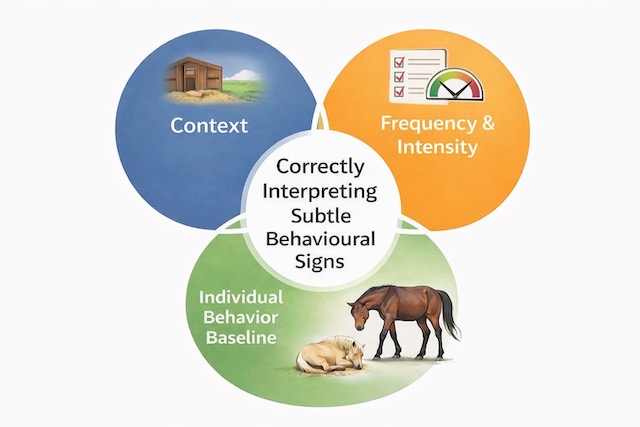
Summary: the three key questions to ask yourself
To distinguish potentially normal behaviours from those indicating early signs of colic, ask yourself these three questions:
- Does this behaviour make sense in this moment and in this situation?
- Is it repeating itself over a short period of time and/or being displayed more strongly than expected?
- Is this how this horse normally behaves at this time of day, in this situation?
The best way to learn to answer these questions correctly is by observing your horse regularly and simply spending time watching how your horse behaves when everything is normal. That is what allows you to build a clear behavioural baseline for that individual horse. Once that baseline is clear, changes become much easier to detect, often very early. In colic, that early recognition makes a very real difference and, in some cases, may even be life-saving.
As a general rule, if you are unsure whether a behaviour is normal or could represent an early sign of colic, it is safest to consider colic as a possibility until proven otherwise and consult your veterinarian.
References
- Bowden A, Burford JH, Brennan ML, England GCW, Freeman SL. Horse owners’ knowledge, and opinions on recognising colic in the horse. Equine Vet J. 2020 Mar;52(2):262–267.
https://doi.org/10.1111/evj.13173